
Last Updated: October 23, 2026
Quick Summary
Natural botox results mean you still look like yourself with softened lines and preserved facial movement. Achieving natural botox results depends on your injector’s skill and conservative dosing that maintains your ability to frown, raise your eyebrows, and express emotion.
- Full Botox results take 7 to 14 days, with peak results at 2 weeks.
- Results typically last 3 to 4 months before the body metabolizes the medication.
- Conservative dosing uses the minimum effective amount to preserve expressions while softening lines.
- Ask your injector about their experience, training credentials, and approach to preserving facial movement.
- Mild redness, small bumps, and minor bruising are normal and usually resolve within a few days.
Table of Contents
- What Natural-Looking Botox Results Actually Mean
- How Botox Works by Relaxing Targeted Muscles
- Key Botox Consultation Questions to Ask Your Injector
- Botox Dosage for Natural Results: Finding Your Right Amount
- Treatment Areas: Forehead Lines, Frown Lines, and Crow’s Feet
- How Long Does Botox Take to Work and Peak Results Timeline
- Botox Aftercare: What to Do and Avoid for Best Outcomes
- Choosing an Experienced, Qualified Injector
- Frequently Asked Questions
What Natural-Looking Botox Results Actually Mean
Natural-looking Botox results mean you still look like yourself. Your face moves. Your expressions show. You don’t look frozen or overdone.
The goal is to soften lines while keeping your facial movement intact.
Many people worry any Botox will make them look “done.” It won’t.
At The Health & Wellness Center, we focus on individualized treatment planning: assessing your facial anatomy, understanding your goals, and dosing conservatively to preserve movement.
How Botox Works by Relaxing Targeted Muscles
Botox works by relaxing the muscles that create wrinkles.
The result is smoother skin. Botox doesn’t erase existing deep lines; it prevents new ones and softens lines already there, working best on dynamic lines that appear when you move your face.
The relaxation is gradual: full results take 7 to 14 days, with peak results at 2 weeks. Judging results too early leads to frustration.
Botox doesn’t last forever; the body metabolizes it over time.
Key Botox Consultation Questions to Ask Your Injector
Your consultation is where natural botox results begin. The right questions reveal whether your injector understands your goals and has the skill to deliver them, and you need to know what a strong answer sounds like.
Verify credentials before you discuss treatment
In the United States, injectors are typically nurse practitioners (NPs), physician assistants (PAs), registered nurses (RNs), or physicians (MDs or DOs). State scope-of-practice rules vary, so ask who will actually perform the injection and what their license allows. Verify most licenses through your state’s medical, nursing, or physician assistant board lookup tool; a legitimate injector won’t hesitate to share their license type and number.
Ask these questions before treatment:
- Who will perform my injection, and what is their license and training? The person who consults you should be the person who injects you unless you are told otherwise in advance.
- How long have you been injecting Botox, and how many treatments do you perform per month? Volume and consistency matter more than a single certification. A common pattern is that experienced injectors perform dozens of treatments per month and can describe how their approach has changed over time.
- Can you show me before-and-after photos of your own work? Ask whether the photos are of patients treated by the injector, not stock images or examples from a training course. Look for patients who still have expression.
Use a short script to describe the movement you want
Most people who worry about looking overtreated are really worried about losing expression. Say that directly. A sample script:
“I want my lines softened, but I want to keep raising my eyebrows and frowning. I would rather start conservative and add more at a follow-up than start strong. Can we plan a two-step approach?”
This tells the injector your priority is movement, signals you’re open to a conservative first dose, and sets up a follow-up visit as part of the plan. Ask them to show you in a mirror which muscles they’ll treat and which they’ll leave alone. If they can’t explain the plan in plain language, that’s useful information.
Evaluate the consultation itself
The consultation is a test. Does the injector listen, ask about your goals, medical history, and prior treatments, examine your face at rest and in motion rather than just a photo, and explain trade-offs like softening a line versus preserving a specific expression?
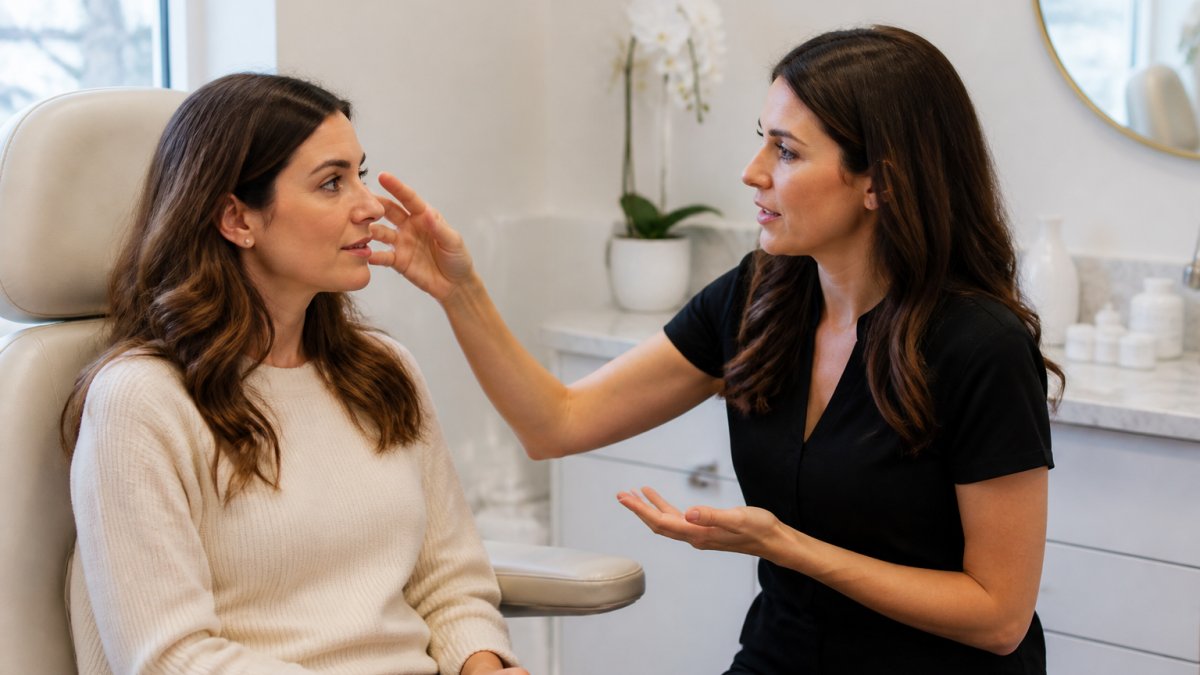
Bring a list of your medications and prior treatments, including any Botox in the past 12 months. Ask the injector to note the product, dose, and injection sites in your record so future visits can build on what worked.
Be cautious of anyone who promises a specific number of units before examining your face, pressures you to treat areas you did not ask about, or dismisses your concerns about looking frozen. Those are signs the plan is being driven by a template rather than by your anatomy and goals.
Botox Dosage for Natural Results: Finding Your Right Amount
Dosage is everything for natural botox results: too little and you won’t see improvement, too much and you lose facial expression.
Dosage varies by person. Factors that affect how much you need include:
- Muscle strength and size (stronger muscles need more)
- Facial anatomy and asymmetry
- Your age and skin elasticity
A qualified injector assesses these factors and customizes the dose to your face and goals rather than using a one-size-fits-all approach.
Conservative dosing is the path to natural results: using the minimum effective amount.
Many patients worry they’ll need more Botox over time, but your body doesn’t build tolerance, the same dose works the same way every time.
Treatment Areas: Forehead Lines, Frown Lines, and Crow’s Feet
Botox works best on specific areas of the face.
Forehead lines run horizontally across your forehead and form from raising your eyebrows repeatedly.
Frown lines (glabellar lines) sit between your eyebrows and deepen when you frown or concentrate.
Crow’s feet radiate from the corners of your eyes and appear when you smile or squint.
The key to natural botox results in these areas is balance.
How Long Does Botox Take to Work and Peak Results Timeline
Botox doesn’t work instantly.
Days 1-3: Nothing visible yet.
Days 4-7: Subtle softening begins. Lines start to relax, but improvement isn’t dramatic yet.
Days 7-14: Results become more obvious. Lines continue to soften.
Week 2-3: Peak results arrive.
Weeks 3-12: Results plateau. You maintain peak improvement for about 10 weeks.
Weeks 12-16: Results begin to fade. Lines gradually return. Movement comes back slowly.
Month 4 and beyond: Results fade completely. Your face returns to its baseline. Many people schedule their next treatment around the 3-month mark to maintain results.
Botox Aftercare: What to Do and Avoid for Best Outcomes
Aftercare advice for Botox mixes evidence-based guidance, provider-specific protocol, and habit. Knowing which is which helps you follow the instructions that matter. The goal is simple: reduce bruising and swelling, avoid pushing the medication into unintended areas, and know when to call your injector.
What is generally supported
- Stay upright for about 4 hours. This is a common provider instruction intended to reduce the chance of the medication spreading to nearby muscles. It is low-risk and easy to follow.
- Apply a cold pack for short intervals. If you have swelling or bruising, a cold pack for about 10 to 15 minutes at a time can reduce inflammation. Use a barrier such as a cloth and avoid pressing hard on the injection sites.
- Avoid rubbing or massaging the treated areas for at least 24 hours. Pressure and massage can move the medication. This is a widely used precaution, though the exact window is provider-specific.
What is provider-specific
Some instructions vary by injector and by the areas treated. Follow the written instructions you are given, and ask if anything is unclear.
- Exercise. Many injectors ask patients to avoid strenuous exercise for 24 hours because increased blood flow may increase bruising. Others allow light activity sooner. Ask what your injector prefers.
- Heat. Saunas, hot tubs, and intense heat are commonly avoided for 24 hours for the same reason. The evidence is limited, but the precaution is low-cost.
- Alcohol. Avoiding alcohol for 24 hours is often recommended because alcohol can thin the blood and increase bruising risk. This is a reasonable precaution, especially if you bruise easily.
If you forget one aftercare instruction, do not panic. Most precautions are aimed at reducing bruising and spread, and a single lapse is unlikely to change your result. Call your injector if you are unsure.
Normal symptoms versus warning signs
Mild redness, small bumps at injection sites, and minor bruising are common and usually resolve within a few days. Headache can occur after treatment and is often mild. These are not typically reasons to worry.
Contact your injector promptly if you notice:
- Severe or worsening swelling, or swelling that spreads beyond the treated area
- Bruising that is large, painful, or expanding
- Asymmetry that is pronounced or does not improve as the two-week mark approaches
Most issues resolve on their own, but your injector should know what is happening. Keep the clinic’s contact information and ask who to call after hours.
Plan your follow-up
A follow-up around two weeks after treatment lets your injector assess the full result and decide whether a small touch-up is appropriate, and it’s the right time to discuss whether you want more or less movement in a specific area. Scheduling it at treatment makes it more likely to happen and gives you a clear point to judge the result rather than guessing in the first few days.
Choosing an Experienced, Qualified Injector
This is the most important decision you’ll make. Your results depend almost entirely on your injector’s skill and judgment.
A qualified injector has formal training and credentials. For Botox, this typically means:
- A nurse practitioner (NP), physician assistant (PA), or medical doctor (MD)
- Specific training in facial anatomy and injection technique
- Hands-on experience with hundreds of patients
Experience matters.
Look for someone who takes time during consultation, asking about your goals, examining your face, discussing your medical history, and explaining their approach.
Ask to see before-and-after photos. Real patient results tell you what to expect. Look for natural-looking outcomes. Do patients still have facial expression?
At The Health & Wellness Center, our team is led by family nurse practitioner Dr. Secil Schodroski, who combines proven medical techniques with advanced technologies.
Trust matters when you’re allowing someone to inject medication into your face.
Frequently Asked Questions
What should I tell my injector to avoid a frozen look?
Be specific about wanting to maintain facial expression and movement. Tell your injector you prefer a conservative approach and want to preserve your ability to smile, frown, and raise your eyebrows. Share photos of celebrities or people whose natural-looking results you admire. Discuss your specific concerns about overdone appearance, and ask your injector to explain how they plan to preserve muscle function while smoothing lines. Clear communication about your goals is essential for achieving natural Botox results.
How much Botox is needed for natural-looking results?
The right Botox dosage for natural results depends on your facial anatomy, muscle strength, and treatment goals. Most practitioners use conservative dosing, starting with smaller amounts and adjusting at follow-up appointments if needed. During your consultation, ask your injector about their dosing strategy and how they personalize treatment for each patient. An experienced injector will assess your facial structure and muscle tension to determine the appropriate dose for your natural-looking Botox results without creating an overdone appearance.
How long do natural-looking Botox results last?
Natural-looking Botox results typically last three to six months. Most patients notice results begin to fade around the three-month mark, though individual timelines vary based on metabolism, muscle mass, and dosage. Many people schedule follow-up or touch-up appointments every three to four months to maintain their results. Your injector can discuss your maintenance schedule during your consultation and help you plan a treatment interval that works for your lifestyle and aesthetic goals.
What should I avoid after Botox to keep results looking natural?
After Botox, avoid rubbing or massaging the treated area for at least 24 hours, as this can cause the product to migrate to unintended muscles. Stay upright for several hours after your appointment, avoid strenuous exercise for 24-48 hours, and skip hot environments like saunas or intense workouts. Don’t lie flat or sleep face-down immediately after treatment. Follow your injector’s specific aftercare instructions carefully. These precautions help ensure the Botox settles properly in targeted muscles for balanced, natural-looking results.
Achieving natural botox results requires the right injector, conservative dosing, and realistic expectations. The goal isn’t to erase your face, it’s to refresh it while keeping you looking like yourself. At The Health & Wellness Center, we specialize in individualized Botox treatment that preserves your natural movement and expression. Schedule a consultation with our team to discuss your goals and learn how we can help you achieve the refreshed, natural look you want.
